Explore the different types of device stands — magnetic phone stands, laptop risers, car phone holders, and dedicated stands. Learn which products fit your brand and target market.
Walk into any electronics accessory aisle or scroll through an online marketplace, and you’ll see dozens of products that all claim to do the same thing: hold your device. But a magnetic phone stand designed for a car dashboard is a fundamentally different product from a vertical laptop dock built for a designer’s desk. They solve different problems, use different materials, and appeal to different buyers.
For brands and businesses sourcing device stands — whether for retail, corporate gifting, or private label — understanding these product categories isn’t just helpful. It’s the difference between stocking what sells and sitting on inventory that doesn’t move.
Here’s a breakdown of the major device stand categories, what each one does best, and which markets they serve.
Phone Stands: The Entry Point for Every Brand
Phone stands are the broadest and most accessible category. They range from $5 impulse purchases to $50 premium desk accessories. Within this category, several sub-types serve distinct use cases.
That level of customization is what transforms a generic product into a branded asset. And it starts with having a manufacturer that genuinely supports OEM/ODM from day one.
Magnetic Phone Stands
Magnetic phone stands use strong magnets (typically neodymium) to hold the phone in place, often paired with MagSafe or MagSafe-compatible systems. They allow one-handed attachment and removal, making them ideal for quick-access scenarios.
Best for: Users who frequently pick up and put down their phone — desk workers, content creators, kitchen users following recipes.
Key design considerations:
- Magnet strength (measured in N — a 12N–15N magnet holds most phones securely)
- Compatibility with non-MagSafe phones (adhesive metal rings expand the market)
- Rotating head for portrait-to-landscape switching
- Base weight and stability — a top-heavy design will tip
Popular materials: Aluminum alloy body with silicone contact pads. The combination of cool metal and soft grip is the industry sweet spot.
Target market: E-commerce, tech accessories retailers, Apple ecosystem accessory brands.
Laptop Stands: The Ergonomic Upgrade
Laptop stands are the fastest-growing segment within device holders, driven by remote and hybrid work adoption. The core value proposition is simple: raise the laptop screen to eye level to reduce neck strain and improve posture. But the category has expanded well beyond that.
Portable Laptop Risers
Foldable, lightweight stands designed to travel with the laptop. They collapse flat or into a compact shape and fit in a laptop bag sleeve. The engineering challenge is achieving stability in a lightweight, foldable form.
Best for: Remote workers, digital nomads, co-working space users, business travelers.
Key design considerations:
- Folded dimensions — must fit in standard laptop bag pockets
- Weight — under 300g is ideal
- Stability when deployed — adjustable feet help compensate for uneven surfaces
- Ventilation — open design allows passive cooling
- Material — aluminum offers the best strength-to-weight ratio
Popular materials: Aluminum alloy, with silicone grip pads at contact points.
Target market: Travel accessory brands, co-working space retailers, corporate IT suppliers.
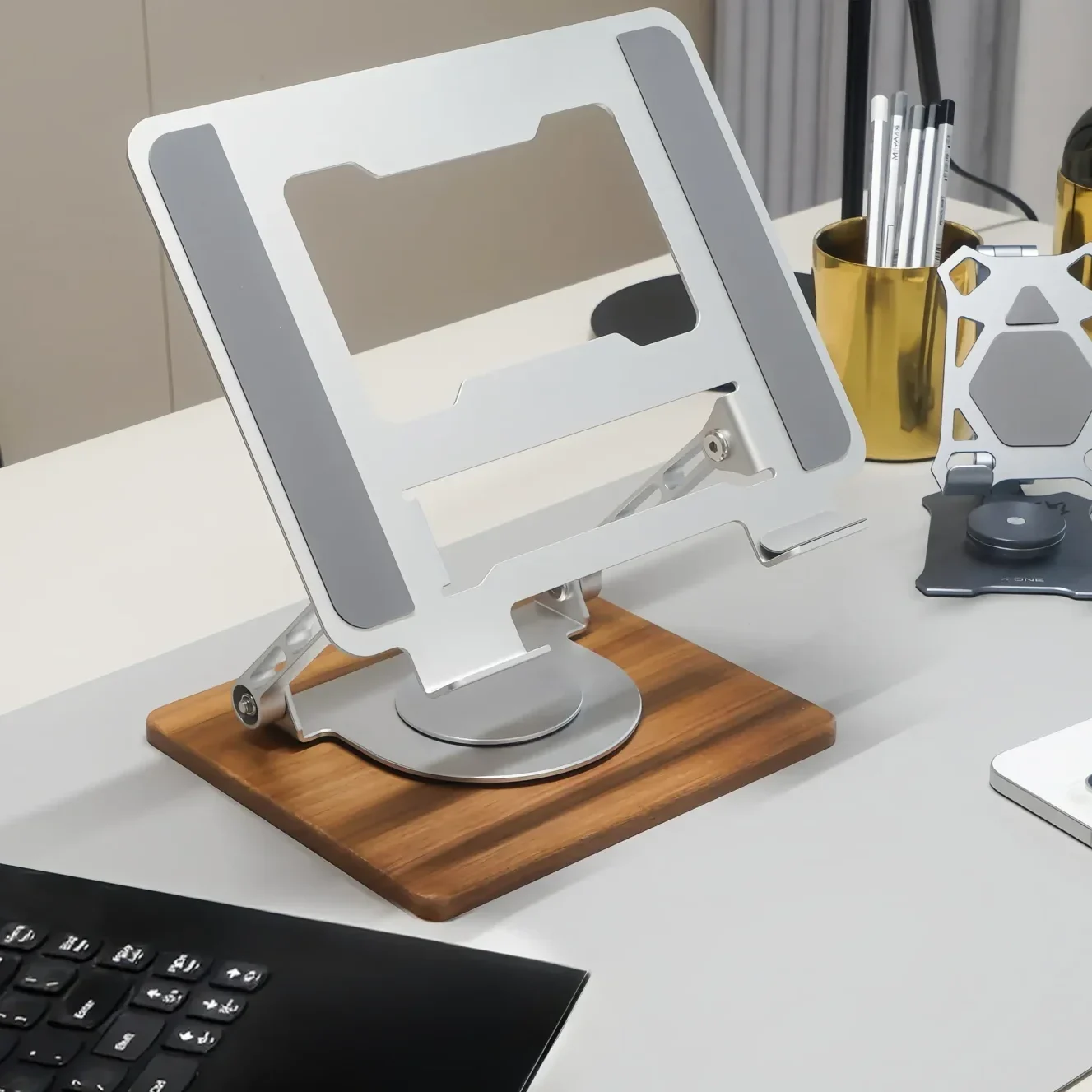
Desktop Laptop Stands
These are heavy, stable, and designed to stay put. Unlike portable risers, they prioritize ergonomic precision over portability. Many offer fine-grained height adjustment, allowing users to position their screen at the exact ergonomic sweet spot.
Best for: Permanent desk setups, home offices, corporate office deployments.
Key design considerations:
- Height adjustment range and mechanism — pinned, ratcheted, or friction-based
- Weight capacity — must handle 16″ laptops (often 2kg+)
- Cable management routing
- Under-stand storage space (keyboard slides underneath)
- Ventilation and heat management for the laptop
Popular materials: Aluminum alloy or steel frame; wood options are popular for aesthetic-focused setups.
Target market: Office furniture retailers, ergonomic accessory brands, corporate procurement.
Laptop Cooling Stands
A subset of desktop stands that integrate active cooling — powered fans that pull heat away from the laptop’s underside. Particularly relevant for gaming laptops, video editing workstations, and any machine that runs hot under load.
Best for: Gamers, video editors, software developers running intensive workloads.
Key design considerations:
- Number and size of fans (more fans at lower RPM = quieter operation)
- USB-powered with passthrough ports
- Fan speed control
- Noise level under load (typically measured in dB)
Popular materials: Metal mesh surface for heat dissipation, plastic frame for cost efficiency.
Target market: Gaming accessory retailers, high-performance computing brands.
Vertical Laptop Stands
A minimalist solution: a vertical dock that holds a closed laptop upright, like a book on a shelf. These save massive amounts of desk space and are popular in setups where the laptop drives an external monitor.
Best for: Multi-monitor desk setups, clutter-free minimalist workspaces.
Key design considerations:
- Slot width adjustability for different laptop thicknesses
- Weighted base to prevent tipping
- Padding inside the slot to prevent scratches
- Material — heavy aluminum or steel is preferred for stability
Popular materials: Aluminum alloy, steel, wood.
Target market: Minimalist desk accessory brands, Apple ecosystem retailers, designer-focused shops.
Dedicated Stands: Specialized Solutions for Specific Devices
Beyond phones and laptops, dedicated stands serve particular devices and use cases. This category is smaller but often commands higher margins because it solves specific, non-generic problems.
Headphone Stands
A stand for over-ear headphones — often combining a headband rest with a cable management hook. Premium models serve double duty as display pieces, making headphones look like art objects when not in use.
Best for: Audiophiles, gamers, studio professionals, high-end desk setups.
Key design considerations:
- Curved headband rest matching headphone contours
- Weighted base for stability
- Cable management hook underneath
- Material and finish — wood and aluminum combos are popular for visual appeal
Popular materials: Aluminum, wood, steel. Premium models often combine two materials.
Target market: Audio accessory brands, gaming peripheral retailers, luxury desk accessory companies.
Tablet / Pad Stands
Purpose-built for tablets rather than phones, with a larger footprint and often heavier construction. Used in point-of-sale systems, kitchen recipe displays, and presentation setups.
Best for: Retail POS, restaurants, conference rooms, home kitchens.
Key design considerations:
- Wider base to support a larger device footprint
- Adjustable angle for glare reduction
- Heavy-duty construction — tablets are heavier than phones
- Commercial-grade durability for POS/restaurant use
Popular materials: Aluminum alloy, steel, heavy-duty ABS.
Target market: Restaurant supply, retail POS system integrators, commercial AV installers.
Book Stands
Designed for reading — holding physical books open at a comfortable angle. Often used in kitchens (cookbooks), study desks, and music stands.
Best for: Students, home cooks, musicians, readers.
Key design considerations:
- Page-holding clips or arms that don’t damage paper
- Adjustable angle
- Sufficient width for large-format books
- Foldability for storage
Popular materials: Wood (classic aesthetic), aluminum (modern), bamboo (eco-friendly).
Target market: Bookstore accessory sections, study/student supply retailers, kitchenware brands.
How to Build a Balanced Product Portfolio
For brands entering the device stand space, the instinct is often to start with the broadest category (phone stands). That instinct is correct — but with a caveat. Here’s a framework for portfolio construction:
Your Anchor Product (60–70% of volume):
Start with one or two desktop phone stand SKUs. Choose a material (aluminum) and a price point (mid-to-premium, $15–40 retail) that aligns with your brand. This product type has the highest addressable market and the lowest educational burden — customers already know they need it.
Your Companion Product (20–30% of volume):
Add a laptop stand. The customer who buys a phone stand for their desk is the same customer who needs a laptop riser. The cross-sell is natural. Start with a portable aluminum riser before expanding into desktop and vertical options.
Your Differentiator (10% of volume, 30% of margin):
Add one specialized stand that competitors don’t offer — a premium headphone stand, a bamboo book stand, or a commercial-grade tablet stand for POS. These products don’t drive volume, but they signal category authority and attract niche buyers with higher willingness to pay.
Your Expansion Path:
Once the first three tiers are performing, expand horizontally: add a magnetic phone stand, a car holder, a cooling laptop stand. Each new sub-type opens a new customer segment without diluting your core positioning.
What to Look for Across Every Product Type
Regardless of which stand category you source, four quality markers apply universally:
- Material honesty. If it’s advertised as aluminum, is it solid aluminum or plastic with a metallic coating? A simple weight test reveals the difference immediately.
- Contact point quality. Where the stand touches the device, is there silicone or rubber padding? Bare metal or hard plastic will scratch phones and laptops.
- Stability under load. A stand that wobbles or tips when a phone vibrates is a return waiting to happen. Test with the heaviest device the stand claims to support.
- Finish consistency. Anodizing should be uniform, edges should be smooth, welds should be clean. These are the details that separate a premium accessory from a commodity.
At Sento, we design and manufacture all major stand categories — from magnetic phone stands and portable laptop risers to car holders, headphone stands, and dedicated tablet mounts. With 28+ proven product designs, 60+ original creations, and a manufacturing facility equipped with nearly 100 sets of CNC metal-processing equipment, we help brands build complete, cohesive device stand portfolios under one manufacturing relationship.
Exploring which stand category fits your brand?
Contact us for product samples across our full catalog, or speak with our engineering team about custom development for any category above.